June 28, 2026
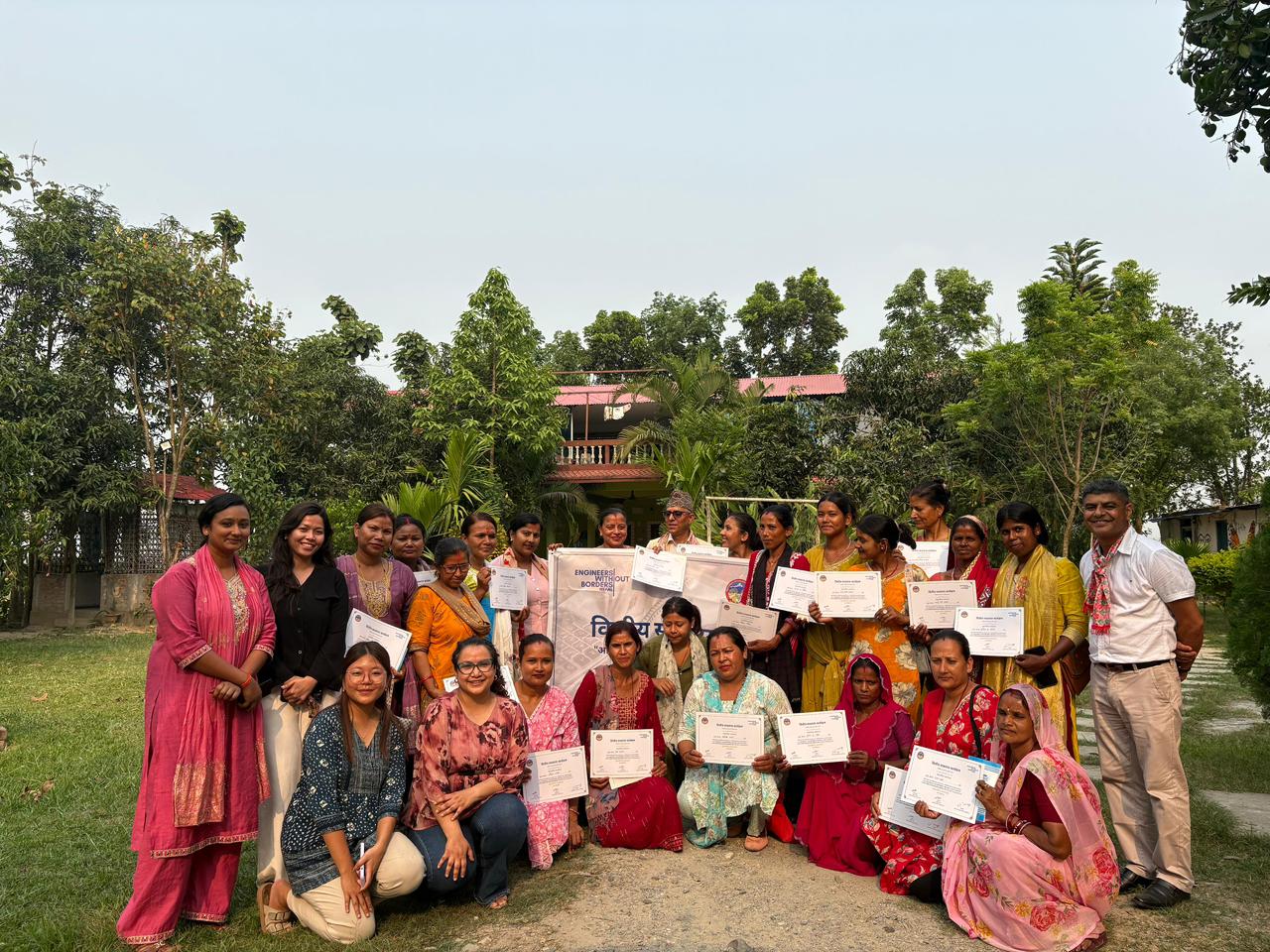
What does financial freedom look like for a housewife managing her family’s expenses on a modest income? Or for a vegetable seller navigating the ups and downs of daily earnings? For over 100 women across eastern and southern Nepal this April, it started with a single day of learning — and it changed the way they see money.
Engineers Without Borders Nepal (EWB-Nepal), with generous financial support from Agriculture Development Bank Limited (ADBL), successfully implemented a multi-district Financial Literacy Program across three districts in April 2026. The program was delivered via intensive, one-day workshops tailored for women participants in Jhapa, Saptakoshi Municipality in Saptari, and Bardibas Municipality in Mahottari — communities identified as having growing financial inclusion activity but persistently low financial literacy, particularly among women.
Why Madhesh and Eastern Nepal, Why Women?
The context matters. According to Nepal Rastra Bank’s baseline financial literacy survey (2022), the overall financial literacy score in provinces like Madhesh sits at approximately 53%, falling well below the national average of 57.9%. Financial knowledge, the hardest gap to close, scores even lower at around 49%. The gender gap makes this picture starker: men consistently outperform women across all three measured components: knowledge, behavior, and attitude.
Women across these regions face compounding barriers: limited educational access, socio-cultural constraints, and historically low participation in formal financial decision-making. With this in mind, EWB-Nepal designed the program specifically to address the needs of women from the ground up using simple, visual, and deeply practical content.
A Day of Learning, Designed for Real Life
The full-day workshop at each location covered seven core modules: Introduction to Financial Literacy, Budgeting and Savings, Investment, Financial Goals and Planning, Financial Services, Digital Financial Services and Fraud, and Insurance. The curriculum followed a consistent four-step structure: Explanation, Activity, Discussion, and Recap, keeping sessions accessible for participants with varying literacy levels.
Rather than relying on text-heavy materials, the program used Nepali-language slides filled with graphical illustrations, pictorial cards, real-life photos, and comparative visuals. Participants compared savings options (home, cooperative, bank, livestock), analyzed borrowing from a friend versus a financial institution, and learned to distinguish life from non-life insurance all through hands-on activities and open group discussions.
A session by an ADBL representative at the venues introduced participants to available banking products and women-targeted loan schemes, creating a direct bridge between the day’s learning and real financial services they could access.
“Sabitri Ko Katha” — Learning Through Play
One of the most celebrated elements of the program was the interactive financial game “Sabitri Ko Katha” (Sabitri Didi’s Story). Teams took on the role of managing the monthly household budget of Sabitri Didi, a vegetable seller navigating daily earnings. The game simulated real-life financial pressures — unexpected crises, investment decisions, financial goal-setting, and emergency fund management — in a format that was engaging, competitive, and deeply relatable.
The game did more than teach concepts; it broke the ice. Early in the day, some participants across the districts were hesitant to speak up in group discussions. By the time Sabitri Ko Katha was underway, the room had shifted — women were actively debating budget decisions, laughing, and advocating for their team’s strategy with confidence.
Stories That Stay With You
In Bardibas (Mahottari), a housewife heard the term “SIP” for the first time in a way that actually made sense. She had always assumed Systematic Investment Plans were for salaried, educated people — not for someone managing a household on a modest income. When the facilitator explained that a SIP could begin with as little as NPR 1,000 per month and showed exactly how to open a Demat account, something clicked. Before the session ended, she had made up her mind to open her account and start investing. “I thought SIP was for big investors,” she told a facilitator. “Now I know it is actually for people like me.”
In Saptakoshi (Saptari), a regular eSewa user learned about QR code substitution fraud for the first time. She had been scanning QR codes at shop counters for months without ever verifying the recipient’s name on the confirmation screen. When the facilitator explained how fraudsters paste counterfeit QR codes over legitimate ones — silently redirecting payments into their own accounts — she recalled several transactions she had completed without a second thought. She left the session committed to verifying every future transaction and planned to pass the knowledge on to her family members.
Similar transformations unfolded in Jhapa, where small-scale women entrepreneurs realized how regular micro-savings could shield their businesses from sudden market dips, shifting their mindset from daily survival to long-term financial planning.
100+ Participants. Three Days. Real Change.
Over a span of three days, more than 100 women completed the program across Jhapa, Saptari, and Mahottari. They came from diverse backgrounds: small-scale entrepreneurs, housewives, beauty parlor owners, tailors, garland makers, cooperative members, and grocery shop operators. By the close of each one-day session, many had made concrete commitments: to open formal bank accounts, begin systematic savings, explore ADBL’s financial products, and verify digital transactions before completing them.
The local impact was underscored by the presence of community leaders, including Mr. Krishna Prasad Dhakal, Mayor of Saptakoshi Municipality, whose involvement highlighted local government commitment to women’s financial empowerment. The program was made possible through the collaboration of key partners — ADBL as the primary funder, local municipal coordinators, Mahila Kendra Vikas Bahuudeshya Sahakari providing local support in Bardibas, and the Bardibas Chamber of Commerce & Industries, which hosted a session and emphasized the importance of women’s economic participation.
Looking Ahead
This program is a step — an important one, but a step. Financial literacy is not built in a single workshop; it grows through continued access, practice, and support. EWB-Nepal remains committed to expanding this work, learning from each implementation, and advocating for sustained financial education for women across Nepal’s underserved communities.
As one facilitator noted at the end of the training series: financial freedom begins not with money, but with understanding. For over 100 women across these three districts this April, that understanding has begun.
—
The Financial Literacy Program was implemented by Engineers Without Borders Nepal (EWB-Nepal) with financial support from Agriculture Development Bank Limited (ADBL). For more information about EWB-Nepal’s programs, contact us at ewbnepal.org.
References
During the implementation of the SRSS Sanitation Project in Roshi, one of the service learners…
Mr. Kapil Dev Regmi, President of Engineers Without Borders International (EWBI), joined the Engineering for…
During the implementation of the SRSS Sanitation Project in Roshi, one of the service learners…
Mr. Kapil Dev Regmi, President of Engineers Without Borders International (EWBI), joined the Engineering for…
In collaboration with various clubs within the Campus, Pulchowk Campus organized a student-led Career Conclave…